
What is Populism?
Exploring political values in a large, independent survey

Years ago, I ran a study through the 2021 Astral Codex Ten Reader Research Survey, investigating the dimensions of personality. The results of my own survey verified that the Big Five is incomplete—we can identify more than 5 dimensions of personality. These results are already published here, but some of us also shared our data with one another. There was another survey called Understanding Your Beliefs, carried out independently by someone I have never met, and I wondered whether the data there would replicate the three factor model of political values I’ve written about before. As many of you know, life has been pretty hard I’ve been busy for a while, but I have a bit more time for digging through data now, and this is the result for their survey on 3220 people:
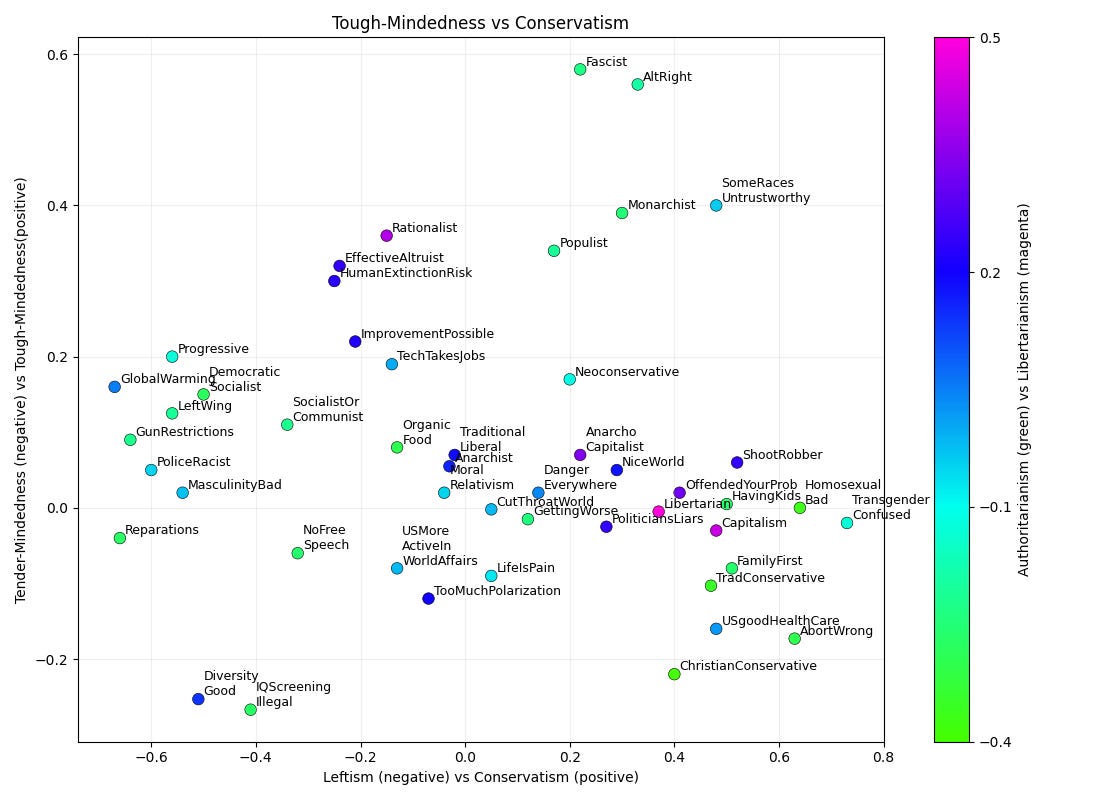
The survey helpfully began with a single left-right self placement item which I used to orient the graph horizontally. I then rotated it so that Libertarianism pointed cleanly into its own dimension, which left Tough-Mindedness remaining as the vertical axis. The result is easily recognizable as the same map that I’ve written about extensively in previous posts; although “Progressive” is the new tough-minded leftist now that communists have wandered a bit towards the center, fascists are right where Eysenck found them in the 1940s.
The first bit of news to me is exactly what “populist” means. Ever since Trump appeared on the scene I’ve been saying “sure, fine, but what is populism?” without getting an answer. Scholars describe populism as a “contested concept”1 whose “definitional precariousness is proverbial.”2 It seems to revolve around opposition to some illegitimate elite who are themselves circumventing democracy and the will of the people.3
Psychological studies do not paint a particularly coherent picture of the typical populist. One study found that “belief in conspiracies with greedy… elites are associated with populism,”4 and another article reports that across the Netherlands, Germany, and the US, low Big Five Agreeableness is a correlate of Populist attitudes.5 My favorite study was from 2021, looking at populists in Turkey and Italy using a variety of measures; these found few consistent traits of populists across the different contexts beyond an endorsement of conspiracy beliefs and a lack of trust in national institutions.
But while these are somewhat interesting, they still don’t give me a very good idea of what populism is in a way that this survey does—nor do they necessarily capture the essence of populism, because they begin with various definitions of what populism ought to be, and then try to measure that. But words have no intrinsic meaning; the meaning of a word like “populism” is really nothing more than what people use it to mean. In other words, the most legitimate way of determining what populism is, it to find people who self-identify as populists and ask them what they believe. Pull the data together in a survey, turn the crank on a nice principal components analysis, and it comes out that, basically:
Populists are tough-minded authoritarians.
Curiously—for a political group that is supposed to be characterized by anti-elitism—populism is remarkably similar to monarchism. This is rather a surprise; it seems to stem from the specific left-right position of populism, and this may be a quirk of our particular sample. A survey in some other language such as Spanish could find populists lean to the left, since left-leaning populism is often considered more typical in Latin America.
So, I spent some time considering whether there might not be some way to test this idea that there are two “populisms.” Populists are often regarded as extremists, rather than merely moderately to the right; if this sample consisted mostly of American-style, conservative populists, with some hard left populists mixed in, this would result in an overall blending in this particular sample that resulted in what looks like a subtly right-leaning populism. This leads to a cleanly testable hypothesis: If there were a left-leaning populism and a right-leaning populism, with few centrist populists, then populists should show greater variability in their conservatism scores than non-populists.
This dataset contained 191 self-identified populists and 3030 non-populists. An F-test on their conservatism scores found their variances differ at p = 1.1x10⁻⁹! Normally we would expect that a self-identified political subgroup would be more homogeneous than the entire survey group, not more varied as we find here with populists.6 In other words, there does indeed seem to be a schism amidst the populists, and this dataset reveals conservatism is not a specific feature of populism.
By contrast, the tough-minded, authoritarian character of populism seems to be a much stronger signal. If so, does this mean that tender-minded libertarians are the sorts of people who are OK with established elites? Like everything else in science, we really need a replication before drawing firm conclusions, but to me, this is a satisfying result, and finally gives me a way I can clearly understand populism: From now on, whenever someone says “populist,” I’m going to decode this as “tough authoritarian, possibly with a unique flavor of manichaean anti-elitism.”
Isn’t Everybody an Authoritarian?
What I find interesting is that so many of the self-identified clusters are decidedly paternalistic or unlibertarian. This is true whether we’re talking about populists, socialists, monarchists, or Christian conservatives. Only rationalists and libertarians have a strong anti-authoritarian leaning, and maybe the reason everyone else is so visibly political is because they tacitly agree that personal freedom isn’t a big deal. Once you agree that authorities, rules, and regulations get to control everything, I suppose it makes sense for you to be seriously invested in what those authorities, rules, and regulations are!
Also worth noting are the way the labels in this survey “work.” Many people are skeptical about psychological methods—what if we ask the questions in a different way, or in a different context; do they mean the same thing? Survey respondents simply ticked a box to indicate whether a specific label like “Populist” or “Christian Conservative” applied to them, while they rated detailed questions using a 5-point Likert scale. But despite the stark difference in framing, the personal labels clustered in very predictable ways with the value statements:
Left Wing is right next door from “We should have a lot of restrictions on the purchase of guns” and “Many police officers in the U.S. are racist against Black people,”
Traditional Conservative and Christian Conservative are both adjacent to “Abortion is morally wrong,”
Libertarian dovetails with “Capitalism tends to be a force for good in the world,” and
Effective Altruist dovetails with the belief that “In most situations, making things way better is absolutely possible.”
But How Trustworthy Are These Findings?
Skeptics and non-psychologists are always concerned about things like whether a study used a convenience sample, or whether the survey questions were biased. I’m not saying that bias and sample problems don’t exist, and I want to be very clear that, like most of my work, this survey used a convenience sample; in this case I don’t even have any idea about what was motivating the choice of questions to ask. But these results are further confirmation that what matters most is A) the sample size, B) the breadth of the questions asked, and C) how adroitly the analysis is carried out.
In a principal component analysis (PCA) like this, we’re looking at the pattern of correlations rather than averages, so even a weird sample (like, say, the readers of Astral Codex Ten) still has enough variation for the relationships to come through clearly with broad enough questions. And because I knew to rotate the first three dimensions in this same way as previous studies, the map came through very cleanly; another researcher might have just called the first unrotated factor “conservatism” and then struggled to identify the other dimensions which would be upside-down and intermingled.
Whether the exact character of populism (and other self-descriptors) will remain fixed across other studies remains to be seen. However, the position of other ideologies has moved only modestly across samples and centuries, so I’m predicting that the findings regarding populism, anarchism, and other novel political descriptors will remain similarly robust across future studies.
Surprises and Other Points of Note
All that being said, there were a few minor differences between the findings from this dataset and other studies I’ve carried out:
Pro-Life Values. Across all surveys pro-life attitudes are tender and conservative, but this dataset found them to be authoritarian as well. This is the default assumption, though it didn’t hold across my previous surveys. I think the most likely reason for this difference is just that now, the sample size is much larger, given that these findings match most people’s expectations.
Monarchists. In past studies carried out in Britain, support for royalty is slightly tender-minded. Why were the self-identified monarchists in this sample tough-minded? I’m really not sure, and this seems rather surprising. My guess is that monarchists in this modern and mostly American sample were probably more influenced by Mencius Moldbug and Trump’s king memes than by Charles III (who by all accounts is a bit of a dud as kings go), but honestly I’m not sure about this.
Human Extinction. Very interesting to find the tough-left quadrant is where people claim “Humanity has a significant chance of going extinct in the next 100 years.” Considering also the tough-leftist endorsement of “Automation and technology is going to rapidly take away many people’s jobs,” it seems that this quadrant is not straightforwardly pro-science. But this shouldn’t be too much of a surprise, considering that this is where Apple Pie lives, and I’ve written about human extinction in the past. Rather, it seems that tough-minded leftists are most interested in speculating on both positive and negative consequences of technology, probably because for them science and technology has more immediacy, more emotional salience than it does for their opponents in the tender conservative quadrant, who are still arguing why the Rapture didn’t happen in 2025 as was predicted on TikTok (or, for the Gen X Christian Conservatives, why all 88 reasons for why the Rapture would happen in 1988 turned out to be wrong).
Censorship. As usual, the woke left (tender-authoritarian leftists) endorse the idea of censoring people without justification; to clarify, the green NoFreeSpeech dot at the lower left stands for “Someone who has been accused of racism or sexism should not be allowed to speak on college campuses.” Keen as I am not to miss an opportunity to make fun of the woke brigade, I will hereby accuse everyone who endorses the above statement of both racism and sexism, and let them sort out whether they should staple their mouths shut before setting foot on university grounds.
Two More Factors
On a more serious note, what’s really wonderful about large samples like these is that the covariance matrix is very precise. Psychometric surveys are noisy instruments, and typically every time you extract one factor under PCA, you’re taking some signal away, leaving a residuum that gets noisier and noisier until it’s very difficult to be confident that what you’re looking at still has signal. But with over 3000 respondents, there was easily enough statistical power to pull out more than just three factors from this dataset.
The downside is that the question set wasn’t as broad as I would have liked. Don’t get me wrong, it was quite broad—but there was nothing about euthanasia, recreational drugs, capital punishment, digital privacy, universal basic income, vegetarianism, vaccination, or the military, let alone the kinds of questions that would really push boundaries on what is out there in terms of attitudes towards topics like unschooling, cryogenics, psychic powers, eugenics, cell phone addiction, the Singularity, historical revisionism, psilocybin therapy, Friedrich Nietzsche, or UFOs. The results of my previous research suggests those questions would have revealed some interesting factors related to how willing people are to go out on a limb about strange ideas.
But there were many questions on oddball political orientations, and on one’s general belief in the goodness of the world we live in. All of these formed interpretable fourth and fifth factors, plotted below. (I’ve kept the colors representing libertarianism the same as above in an attempt to make it easier to read each graph.)
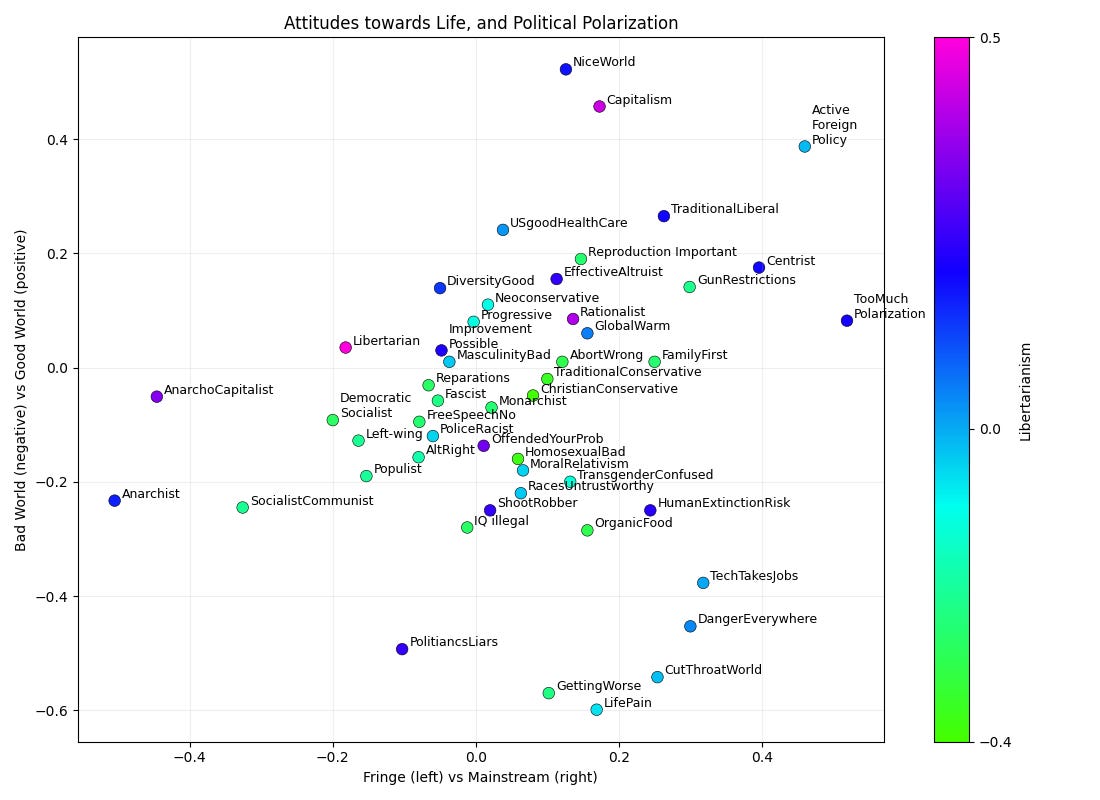
The highest loading items in the vertical dimension help us identify this as a dimension of overall optimism, trust in the world, and subjective well-being. Meanwhile, the horizontal dimension is pretty obviously pitting oddball and extremist political groups like anarchists and communists against centrists who don’t like such a diverse and divided political landscape.
Populists show up at the dissatisfied, extreme lower left corner of the graph; they are somewhat pessimistic about the world and rather outside of the mainstream. Anarchists and communists show up far on the fringe, along with people like me who dearly wish America would seriously stop interfering in other countries, because I think it has a marked tendency to foist its growing craziness on the rest of the world. Say what you will about North Korea, but Kim Jong Il has had virtually no impact on life outside of East Asia; people across the entire world are left shaking their heads and wondering how America is going to affect their lives next week.
The vertical dimension is more interesting. Often factors require a great deal of interpretation or argumentation to make sense, but this dimension is extremely obvious. Optimistic attitudes relating to an overall trust in the world and satisfaction with life are found at the top; negative attitudes are found at the bottom.
But why does the dimension exist? Why do some people believe “The world is a place where working hard and being nice pays off” while others think “Life in this world is usually pain and suffering?” The most typical interpretation found in academia is that the status quo is unjust, but some people are benefitting from the situation as it is, and will take pains to defend what they therefore regard as a just world. Meanwhile, those who are exploited, or exposed to the problems inherent in the system, are marginalized and ignored by those who harbor just world beliefs.
But the usual line also has it that conservatives believe in the myth of a just world, when out of all the self-identified political labels, it’s “traditional liberal” that shows the most overall optimism and trust in institutions. The explanation for this result very likely arises from the time the survey was carried out—do you remember the summer of 2021? That was when Biden had been elected president, but psychologists were still publishing articles like “Understanding gender differences in rape victim blaming: The power of social influence and just world beliefs”7 as an unsubtle means of pathologizing conservative men.
And frankly, I have little patience for the kind of people who push this line; they were totally blindsided by Trump’s first election because they were totally unconcerned about what life was like for Trump’s voter base: uneducated white men on the right who have been dying in droves of what sociologists call deaths of despair—alcoholism, drug overdose, and suicide.
Of some interest is the fact that this phenomenon could never be explained by institutional racism. But it could be explained by persistent attempts to blame all of America’s problems on institutional racism; for some time, educated whites managed to deflect charges of racism onto their less educated peers, with results that should be familiar by now: Where ‘despair deaths’ were higher, voters chose Trump.
So while there may be something to the idea that the self-satisfied belief in a just world is what drives people to be optimistic about the status quo, it also looks like the status quo beliefs are more aligned with normie idea on the right side of the graph, against fringe beliefs on the left side of the graph.
Instead, I do have a useful alternative way of interpreting the vertical dimension: some people are jittery, paranoid, not very intelligent, in poor health, out of luck, or otherwise not doing very well in the world because there is something wrong with them. If life dealt you a losing hand, and you think things are getting worse, you are going to be understandably leery of capitalism. If you aren’t competitive on the job market, you’ll have a reason to think IQ tests might be rigged. If your health is failing, you may very well be concerned about pesticides in food, or issues with the US health care system. If you’ve ever spent much time riding the bus or visiting homeless shelters, you’ll have ample opportunity to engage with people who think everything is rigged, politicians are all liars, and life is unfair.
Unfortunately we have no way of testing this idea using the dataset at our disposal because there were no questions asking respondents about their personalities, their social status, or even their age or gender. Nevertheless, I’m very grateful to the anonymous researcher who shared their data with me.
Conclusion
This dataset of 3220 people from the 2021 Astral Codex Ten survey replicated the three dimensions of political values already known as:
Conservatism vs Leftism,
Tough-Mindedness vs Tender-Mindedness, and
Libertarianism vs Paternalism,
while extending the analysis to two novel dimensions that look like:
Mainstream vs Fringe political affiliation, and
Optimism vs Pessimism.
Self-identified populists were found to be tough-minded and paternalistic, as well as somewhat fringe and pessimistic, but were more heterogeneous in terms of left-right beliefs than non-populists. A replication will be necessary before considering these findings definitive.
Thanks for reading Things to Read! Feel free to share your own interpretation of these findings in the comments below.
Rovira Kaltwasser, Cristóbal (2018). "How to define populism? Reflections on a contested concept and its (mis)use in the social sciences". In Fitzi, Gregor; Mackert, Juergen; Turner, Bryan (eds.). Populism and the Crisis of Democracy, Volume 1 (Concepts and Theory). New York: Routledge. p. 62.
Urbinati, N. (2019). Political theory of populism. Annual review of political science, 22(1), 111-127.
De Cleen, B. (2019). The populist political logic and the analysis of the discursive construction of ‘the people’and ‘the elite’. In Imagining the Peoples of Europe (pp. 19-42). John Benjamins.
Castanho Silva, B., Vegetti, F., & Littvay, L. (2017). The elite is up to something: Exploring the relation between populism and belief in conspiracy theories. Swiss political science review, 23(4), 423-443.
Bakker, B. N., Rooduijn, M., & Schumacher, G. (2016). The psychological roots of populist voting: Evidence from the United States, the Netherlands and Germany. European Journal of Political Research, 55(2), 302-320.
As a sanity check on this process, I repeated the F-test with self-identified Christian Conservatives, finding this group was indeed more homogeneous in terms of conservatism than the main sample, p = 0.0014. So with Christian conservatives you know what you’re dealing with; not so much with the populists!
Pinciotti, C. M., & Orcutt, H. K. (2021). Understanding gender differences in rape victim blaming: The power of social influence and just world beliefs. Journal of interpersonal violence, 36(1-2), 255-275.
Very interesting study, thankyou
thanks