
Is Autism Just Made Up?
Maybe every diagnosis is just made up

Autism is lately in the air—or at least it is for me. My kids have autistic friends, various people I know at work are said to be “on the spectrum,” and weird behavior on the part of our clients is attributed to autism. While I believe these family friends genuinely qualify as autistic, the other cases make me skeptical about the way the label is thrown around lately.
On the one hand, people at r/AutisticPride compresses the entire spectrum into a single way of being with statements like,
Autism is a neurotype in which certain aspects of the brain develop in different directions compared to an allistic (not Autistic) person’s brain… Autistic people are connected by common experiences, challenges, vulnerabilities, interests, habits and inequities.
And then on the other hand, Aimee Grant at The Conversation says there is so much variety within autistic people as a whole that there is no Autistic spectrum at all:
Autism is made up of many different traits and needs, which show up in unique combinations. Some autistic people rely heavily on routine, while others find comfort in repetitive movements known as “stimming”. And some have an intense focus on particular topics, a concept researchers call “monotropism”.
There are also known links with physical conditions such as hypermobility. Because autism is made up of all these different elements, there can be no single line on which every autistic person is placed.
It’s easy to roll one’s eyes at this kind of argument, particularly when the motivation behind it is made explicit:
Underlying all these debates is a deeper concern that dividing autistic people into categories, or arranging them on a spectrum, can slip into judgments about their value to society. In the most extreme form, such hierarchies risk dehumanising those with higher support needs. It’s something some autistic campaigners warn could fuel harmful political agendas.
But we’ve actually known for years that autism really is a multifactoral construct—in plain English, this means a person can be autistic in more than one way. In 2007 the Autism Diagnostic Observation Schedule (ADOS) was examined under factor analysis which found two factors, Social Affect and Restricted, Repetitive Behaviors;1 this has since been confirmed in later versions of the ADOS.23
The Social Affect factor consists of things like,
“Unusual Eye Contact”
“Gaze and Other Behaviors”
“Frequency of Vocalization"
“Quality of Social Overtures” and
“Gestures,”
while Repetitive Behaviors includes,
“Stereotyped Language,”
“Unusual Sensory Interest,”
“Repetitive Interests,” and
“Hand Mannerisms.”
Of course, there are many more tools for measuring autism, like the standard Autism Diagnostic Interview-Revised, or self-report scales such as the Autism Spectrum Quotient (AQ) or the Subthreshold Autism Trait Questionnaire (SATQ). They essentially measure the same thing,45 though we might wonder how they could end up working roughly the same way if they’re different scales.
It helps to understand that any psychometric questionnaire is essentially a series of statements people agree or disagree with, all added up and given a name. Even though there may be many factors underlying autism, and even though there are often clinical protocols and sophisticated statistics at play, you don’t really have to bother with them. You could just come up with items to measure what looks like “IDK, autism?” and give them to 500 people, and what you’ll get will actually be useful and interesting and meaningful because some people answer differently from others. You just shouldn’t be surprised that you’re ultimately measuring the same things as other people with their scales measuring “introversion” or “inflexibililty” or “sensitivity:”
[W]e have shown across two studies that a majority of scales designed to measure ARTs [Autism-Related Traits] in the general population can plausibly be located within the space described by the FFM [Five Factor Model], and that some of these scales approach redundancy with existing FFM facets. These findings suggest that at least some ARTs may be contiguous with ‘‘normal’’ personality traits (or potential ‘‘sibling constructs’’), as has previously been demonstrated for other clinically relevant traits.6
The paper quoted above is referencing work from the older five factor model. More modern research gives a slightly clearer picture, with different subscales of two measures of autism showing correlations past to r = -0.6 with Extraversion and r = -0.2 with Openness; regression analysis has both low Extraversion and low Openness emerging as significant predictors of autism scores, and “HEXACO accounted for 35.8% of the variance in autistic traits measured by the AQ and 37.2% of the variance in the SATQ.”9
Because the AQ is a self-report instrument, I did wonder whether this had been confirmed using the more carefully administered ADOS. What I found was a 2016 study comparing the average personalities of two groups of autistic individuals with a third group who, after treatment, no longer qualified as autistic; those who were no longer autistic scored higher in Extraversion than both autistic groups, and higher in Openness than one autistic group.7
This is exactly what we would expect if autism were basically what you get when a person is very introverted, and rather low in Openness to Experience. It isn’t a surprising result, but personally, I think its really useful, not only because it suggests possible treatments for autism (see if it’s possible to raise Extraversion and Openness), and likely friendship pools for autists in the general population (basically anywhere introverts roam). But also, it allows the rest of us who aren’t really on the spectrum at all to hear “autistic” and immediately translate to “introverted, slightly unimaginative” and get on with our lives.
Are you sure that’s it? That’s really all there is to autism?
Well, if you’re not too keen to get on with your life, there might be more to the story.
When doctors are making a diagnosis of autism, they won’t likely use a framework like the ADOS alone. Generally they’ll also combine this with a structured interview,8 and consider a number of additional issues, like a person’s general risk factors for autism spectrum disorder:9
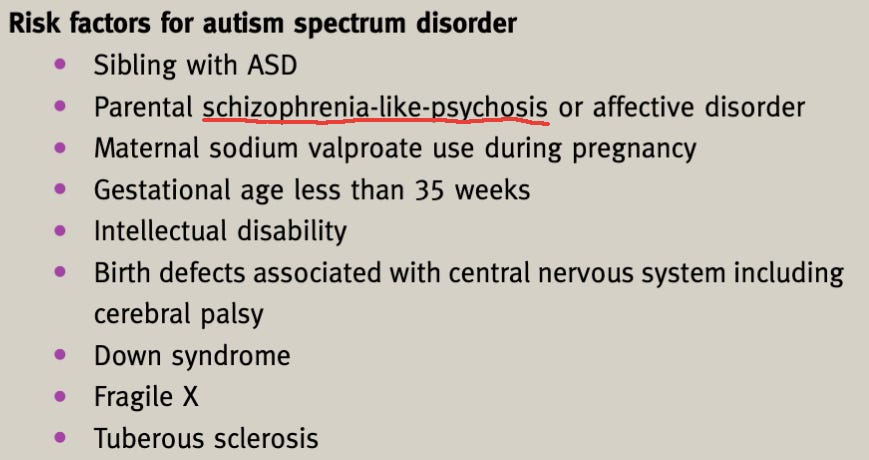
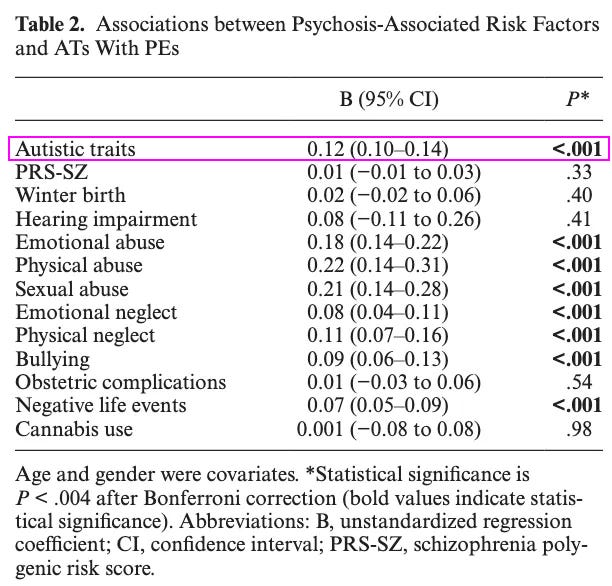
Clever readers may suspect I underlined the schizophrenia-like-psychosis risk in red for a reason. In fact, while the AQ is known to be a good screening tool for autism in the general population, it also returns elevated scores for people with schizophrenia spectrum disorders.10 Some researchers have concluded from these findings that the AQ has poor discriminant validity since it can’t distinguish autistic and psychotic people,11 but is this really a problem with the scale if autistic traits predispose a person to psychotic experiences?12
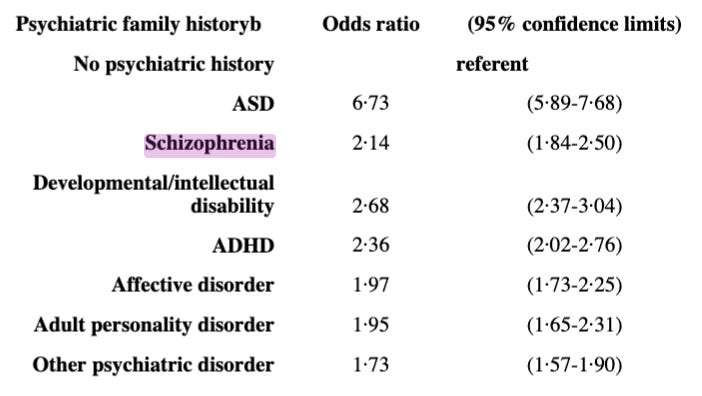
We can verify this relationship the other way as well—Having a family history of schizophrenia (along with ADHD, intellectual disability, and other personality disorders) also increases the risk for Autism Spectrum Disorder:13
This is what we would suspect if there were a genetic link between schizophrenia risk and autism spectrum disorders. And well, when we look at polygenic scores, it turns out, there is a genetic link between schizophrenia risk and autism spectrum disorders:
We also found an indirect pathway suggesting that the association between genetic risk for ASD and psychotic experiences may be mediated by social impairment…14
So how do we account for this using a dimensional model like the HEXACO? Although research is still sparse, we do know there’s actually a seventh trait called Disintegration (D) that describes a person’s overall level of psychosis or schizophrenia-proneness through traits like general executive dysfunction, perceptual distortions, paranoia and conspiracy beliefs, and magical thinking. To date, we’re missing modern studies measuring D in autistic subjects; Disintegration is too new a concept to have been widely used for what we’re after. The best proxies we have for D are scales measuring schizotypy, like the O-life (available here; I recommend trying the short form to get a feel for the questions).
I’ll say right now that I do realize many people like to bandy about the notion that traits from autistic and schizophrenic clusters are somehow opposite to one another. Scott Alexander has said this very directly: “a lot of features of schizophrenia and autism seem to be opposites of each other.” But we’ve known for more than a decade that a common psychotic-prone personality underlies both kinds of traits. For example, research from 2011 found measures of schizotypy (the O-Life) and autism (the AQ) correlate at r = 0.46 (p < 0.001).15 This kind of relationship isn’t what we would expect from the general schizotypy profile, which shows only modestly reduced Extraversion, combined with increased Openness (again using the O-LIFE).16
Further research in the same vein confirms autism is related to all facets of schizotypy—positive, negative, and disorganized—as well as generalized conspiracy beliefs and endorsement of misinformation:17
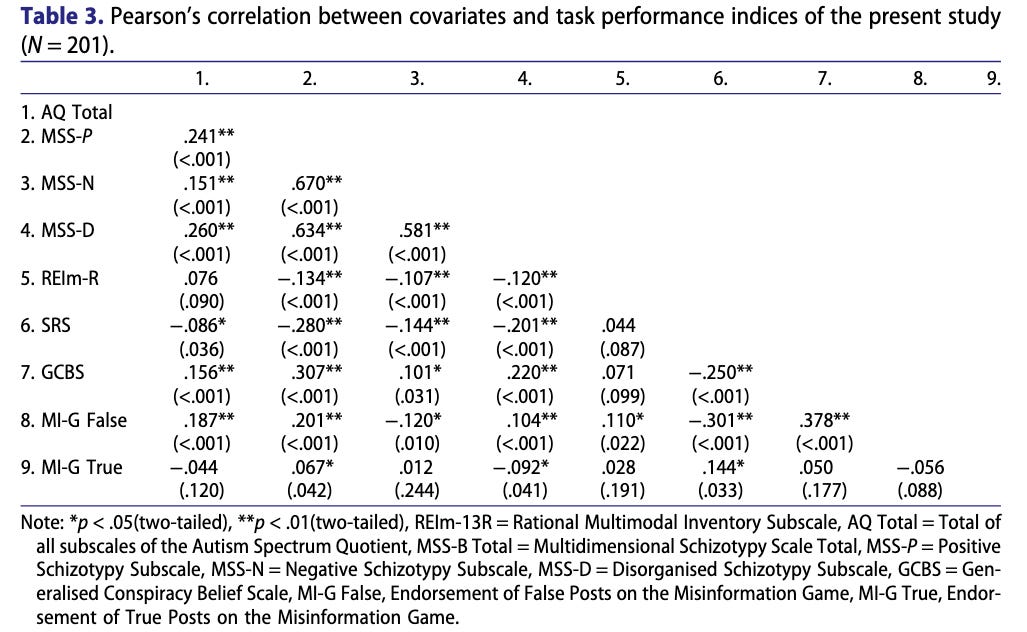
In other words, autism is probably more than just introversion with a dash of mundane-mindedness; there’s some underlying weirdness there as well, making autists close cousins to schizophrenics and schizotypes.18
What all the diagnoses really mean
The main takeaway from all this is that there’s no need for autism as a diagnosis; we can just use regular personality traits like introversion, (low) Openness, and general Disintegration or psychosis-proneness to describe autism.
If we do want to talk about a “spectrum,” that spectrum is just Disintegration, a general predisposition to mental disorders. Ideally, what we would have is a clean measure of Disintegration, free of contamination from the other HEXACO traits, and then, a study comparing “all the diagnoses” to that. Until then, when we want to clarify where every diagnosis lies in terms of Disintegration, we’re left with some indirect inferences drawn from a series of studies, and you’re free to interpret how unhinged you think autism, ADHD, Bipolar, and OCD really are. But for everything else, the picture emerging after decades of research is…
Asexual: “Introverted, imaginative.”19
Autistic: “Introverted, slightly unimaginative. Also a bit unhinged.”2021
Bipolar: “Unhinged.”24
Depressed: “Introverted and unhinged.”25
Dyslexic: “Has trouble reading… Not much else, really”26
OCD: “A bit introverted, possibly well organized, probably unhinged.”27
Paranoid: “Unhinged and vaguely antisocial.”28
Psychopath / Grandiose Narcissist: “Classic Serpent—dishonest and unemotional.”29
Schizotypal: “Unhinged, slightly introverted, perhaps a bit imaginative.”32
Vulnerable Narcissist / BPD: “Introverted Spider—dishonest and emotional”3334
At this time, the only diagnosis which shows a clear separation from broad personality traits is dyslexia. Congratulations, dyslexics! You have a diagnosis that really exists, in the sense that we absolutely need it to describe what’s going on for you—there’s no meaningful way to represent what’s going on with your inability to read with Extraversion, Conscientiousness, or any other psychological trait—not even IQ.3536
Everyone else with a diagnosed mental condition: it’s still possible that you’re quite special! But there are signs that your diagnosis is just evidence you have an unusual and maybe not-so-great personality. Of course, even if it’s true, this wouldn’t mean you shouldn’t be accommodated, it wouldn’t mean we shouldn’t make an effort to understand you, and it wouldn’t mean you shouldn’t receive the help you need. What it would mean is that the reason you may need accommodations, understanding, and assistance is because of these broad personality traits which make it difficult for everyone who has them to interact with others, regardless of the label we apply.
That’s all a diagnosis is: a label. For a long time the labels seemed to be useful, but as the labels proliferate and diagnoses become more flexible, the question arises as to whether the labels are useful anymore. Maybe we’re finally reaching the point that we’re better off without them. This is very much the way I feel.
Thanks for reading Things to Read!
Gotham, K., Risi, S., Pickles, A., & Lord, C. (2007). The Autism Diagnostic Observation Schedule: revised algorithms for improved diagnostic validity. Journal of autism and developmental disorders, 37(4), 613-627.
Chojnicka, I., & Pisula, E. (2017). Adaptation and validation of the ADOS-2, polish version. Frontiers in psychology, 8, 1916.
Hus, V., & Lord, C. (2014). The autism diagnostic observation schedule, module 4: revised algorithm and standardized severity scores. Journal of autism and developmental disorders, 44(8), 1996-2012.
Sut, E., Ayaslan, Z., Cetin, S., Turan Kaya, T., Gundogan Kucuksahin, N., Halac, E., & Ciray, O. (2025). Validity and Reliability of the Turkish Version of the Subthreshold Autism Trait Questionnaire (SATQ-TR). Journal of Autism and Developmental Disorders, 1-12.
Baron-Cohen, S., Hoekstra, R. A., Knickmeyer, R., & Wheelwright, S. (2006). The Autism-Spectrum Quotient (AQ)—Adolescent Version: Baron-Cohen, Hoekstra, Knickmeyer, and Wheelwright. Journal of autism and developmental disorders, 36(3), 343-350.
Widjaja, E. S., Spackman, E. K., Bainbridge, T. F., Ludeke, S. G., Uljarevic, M., Hudry, K., & Smillie, L. D. (2025). The Utility of the Five Factor Model of Personality as an Organizing Framework for Autism-Related Traits. Assessment, 10731911251326395.
Suh, J., Orinstein, A., Barton, M., Chen, C. M., Eigsti, I. M., Ramirez-Esparza, N., & Fein, D. (2016). Ratings of broader autism phenotype and personality traits in optimal outcomes from autism spectrum disorder. Journal of autism and developmental disorders, 46(11), 3505-3518.
Commonly, the Autism Diagnostic Interview–Revised (ADI-R).
Yates, K., & Le Couteur, A. (2016). Diagnosing autism/autism spectrum disorders. Paediatrics and Child Health, 26(12), 513–518. https://doi.org/10.1016/j.paed.2016.08.004
Fusar-Poli, L., Ciancio, A., Gabbiadini, A., Meo, V., Patania, F., Rodolico, A., ... & Aguglia, E. (2020). Self-reported autistic traits using the AQ: a comparison between individuals with ASD, psychosis, and non-clinical controls. Brain Sciences, 10(5), 291.
Naito, K., Matsui, Y., Maeda, K., & Tanaka, K. (2010). Evaluation of the validity of the Autism Spectrum Quotient (AQ) in differentiating high-functioning autistic spectrum disorder from schizophrenia. The Kobe journal of the medical sciences, 56(3), 116-124.
Karacam Dogan, M., Prachason, T., Lin, B., Pries, L. K., Arias-Magnasco, A., Bortoletto, R., ... & Guloksuz, S. (2025). The Moderating Role of Genetic and Environmental Risk Factors for Schizophrenia on the Relationship between Autistic Traits and Psychosis Expression in the General Population. Schizophrenia Bulletin Open, 6(1), sgaf005.
Schendel, D., Munk Laursen, T., Albiñana, C., Vilhjalmsson, B., Ladd‐Acosta, C., Fallin, M. D., ... & Agerbo, E. (2022). Evaluating the interrelations between the autism polygenic score and psychiatric family history in risk for autism. Autism Research, 15(1), 171-182.
Velthorst, E., Froudist-Walsh, S., Stahl, E., Ruderfer, D., Ivanov, I., Buxbaum, J., ... & Reichenberg, A. (2018). Genetic risk for schizophrenia and autism, social impairment and developmental pathways to psychosis. Translational psychiatry, 8(1), 204.
Russell-Smith, S. N., Maybery, M. T., & Bayliss, D. M. (2011). Relationships between autistic-like and schizotypy traits: An analysis using the Autism Spectrum Quotient and Oxford-Liverpool Inventory of Feelings and Experiences. Personality and Individual Differences, 51, 128–132. doi:10.1016/j.paid.2011.03.027
Asai, T., Sugimori, E., Bando, N., & Tanno, Y. (2011). The hierarchic structure in schizotypy and the five-factor model of personality. Psychiatry research, 185(1-2), 78-83.
Georgiou, N., Balzan, R. P., Delfabbro, P., & Young, R. (2024). People with autistic traits are more likely to engage with misinformation and conspiracy theories in a simulated social media context. Cognitive Neuropsychiatry, 29(4–5), 286–305. https://doi.org/10.1080/13546805.2024.2443576
There’s also this, which didn’t exactly support the point, but fits into the general theme: “People with an autism diagnosis reported sharing more false political information both accidentally and on purpose.” Georgiou, N., Delfabbro, P., & Balzan, R. (2021). Autistic traits as a potential confounding factor in the relationship between schizotypy and conspiracy beliefs. Cognitive Neuropsychiatry, 26(4), 273-292.
Bogaert, A. F., Ashton, M. C., & Lee, K. (2018). Personality and sexual orientation: extension to asexuality and the HEXACO model. The Journal of Sex Research, 55(8), 951-961.
Yates, K., & Le Couteur, A. (2016). Diagnosing autism/autism spectrum disorders. Paediatrics and Child Health, 26(12), 513–518. https://doi.org/10.1016/j.paed.2016.08.004
Russell-Smith, S. N., Maybery, M. T., & Bayliss, D. M. (2011). Relationships between autistic-like and schizotypy traits: An analysis using the Autism Spectrum Quotient and Oxford-Liverpool Inventory of Feelings and Experiences. Personality and Individual Differences, 51, 128–132. doi:10.1016/j.paid.2011.03.027
Gomez, R., & Corr, P. J. (2014). ADHD and personality: A meta-analytic review. Clinical psychology review, 34(5), 376-388.
Ettinger, U., Joober, R., De Guzman, R., & O’DRISCOLL, G. A. (2006). Schizotypy, attention deficit hyperactivity disorder, and dopamine genes. Psychiatry and Clinical Neurosciences, 60(6), 764-767.
Knežević, G., Lazarević, L. B., Bosnjak, M., & Keller, J. (2022). Proneness to psychotic‐like experiences as a basic personality trait complementing the HEXACO model—A preregistered cross‐national study. Personality and Mental Health, 16(3), 244-262.
Knežević, G., Lazarević, L. B., Bosnjak, M., & Keller, J. (2022). Proneness to psychotic‐like experiences as a basic personality trait complementing the HEXACO model—A preregistered cross‐national study. Personality and Mental Health, 16(3), 244-262.
Tops, W., Verguts, E., Callens, M., & Brysbaert, M. (2013). Do students with dyslexia have a different personality profile as measured with the big five?. PloS One, 8(5), e64484.
Zhang, L., & Takahashi, Y. (2024). Relationships between obsessive-compulsive disorder and the big five personality traits: A meta-analysis. Journal of Psychiatric Research, 177, 11-23.
Knežević, G., Lazarević, L. B., Bosnjak, M., & Keller, J. (2022). Proneness to psychotic‐like experiences as a basic personality trait complementing the HEXACO model—A preregistered cross‐national study. Personality and Mental Health, 16(3), 244-262.
Lee, K., & Ashton, M. C. (2005). Psychopathy, Machiavellianism, and narcissism in the Five-Factor Model and the HEXACO model of personality structure. Personality and Individual differences, 38(7), 1571-1582.
Knežević, G., Lazarević, L. B., & Scherhag, J. G. (2024). Redefining personality structure: Emerging evidence for the inclusion of disintegration/psychoticism in contemporary trait taxonomies.
Knežević, G., Lazarević, L. B., Bosnjak, M., & Keller, J. (2022). Proneness to psychotic‐like experiences as a basic personality trait complementing the HEXACO model—A preregistered cross‐national study. Personality and Mental Health, 16(3), 244-262.
Ashton, M. C., & Lee, K. (2012). Oddity, schizotypy/dissociation, and personality. Journal of Personality, 80, 113–134.
Gubler, D. A., Janelt, T., Roth, M., & Troche, S. J. (2025). The Hidden Narcissus in the Orchid: The relationship between sensory processing sensitivity, narcissism, self-esteem, and the HEXACO personality traits. Personality and Individual Differences, 233, 112891.
Roters, J., & Book, A. (2023). Using the HEXACO to explain the structure of borderline and psychopathic personality traits. Personality and Mental Health, 17(4), 352-362.
Tanaka, H., Black, J. M., Hulme, C., Stanley, L. M., Kesler, S. R., Whitfield-Gabrieli, S., ... & Hoeft, F. (2011). The brain basis of the phonological deficit in dyslexia is independent of IQ. Psychological science, 22(11), 1442-1451.
Ferrer, E., Shaywitz, B. A., Holahan, J. M., Marchione, K., & Shaywitz, S. E. (2010). Uncoupling of reading and IQ over time: Empirical evidence for a definition of dyslexia. Psychological science, 21(1), 93-101.
This does not match my experiences at all. But first, let me tell you where I am coming from: before the word autism became popular, my type was called geek, nerd, engineer, programmer. Mr Spock, Dr. House, reason-and-logic.
This might be interpreted as low emotional intelligence or empathy, but that is not sure, whenever there is something important, I can put myself into other people's shoes and figure out analytically, based on the circumstances, how they feel.
It is the small emotions that don't work well: why do people want me to greet them and ask them how they are before I tell them what I want?
In that case I cannot put them into their shoes because I certainly do not need that.
Maybe it just boils down to the experience of a bullied kid. When you were hurt a lot, then small rudeness, simply the lack of warmth does not disturb you anymore, and it is hard to see why it disturbs others.
Hypermobility? my ED survivor extroverted daughter with dyslexia.
Looking at the main lists under Social Affect factor and Repetitive Behaviors, I don't do any of the latter, but all of the former (but I don't get gestures...??), fairly mildly compare to those with a diagnosis of autism. openness is high, and only get anxiety in approaching a transitional space for the first time (knocking on a door at some party I think I have been invited to... I have but that is how it feels). And slow with empathy but then it can be overwhelming at times.
The most interesting topic mentioned above,"for me" is monotropism: https://whyweshould.substack.com/p/monotropism
The schizotypals have an unalterable special project of themselves, it's beyond a mere monotropic interest (that may pass depending on openness) as it dives down into the singularity of themselves, some more soft grandiose and silky covert narcissisms are a veneer compared to that.
Thanks for you work here.